Assign the parts before the chore
Ambiguous shared jobs make it harder to know what each child contributed. Split the task into visible parts and agree on the handoff. If a dispute happens, ask about the specific actions without treating the conversation as a competition to blame someone. A clearer next assignment is often more useful than adding surveillance or requiring proof photos. Keep public examples generic, and avoid making children’s private task histories part of a household argument.
A worked family example
One child carries lightweight cups to the agreed place; the other stacks placemats. The adult checks those two outcomes rather than treating clear the table as a single ambiguous job.
A plan to adapt
| Part of the plan | A concrete choice |
|---|---|
| Contribution A | Lightweight cups moved to the agreed place |
| Contribution B | Placemats stacked |
| Adult check | Review both outcomes |
| Next attempt | Repeat the clear ownership rather than a vague shared label |
Try this in your household
- Split the shared label into two observable contributions.
- Agree on who owns each part.
- Check the finished results neutrally.
- Improve the next assignment if credit was unclear.
Where the app can help
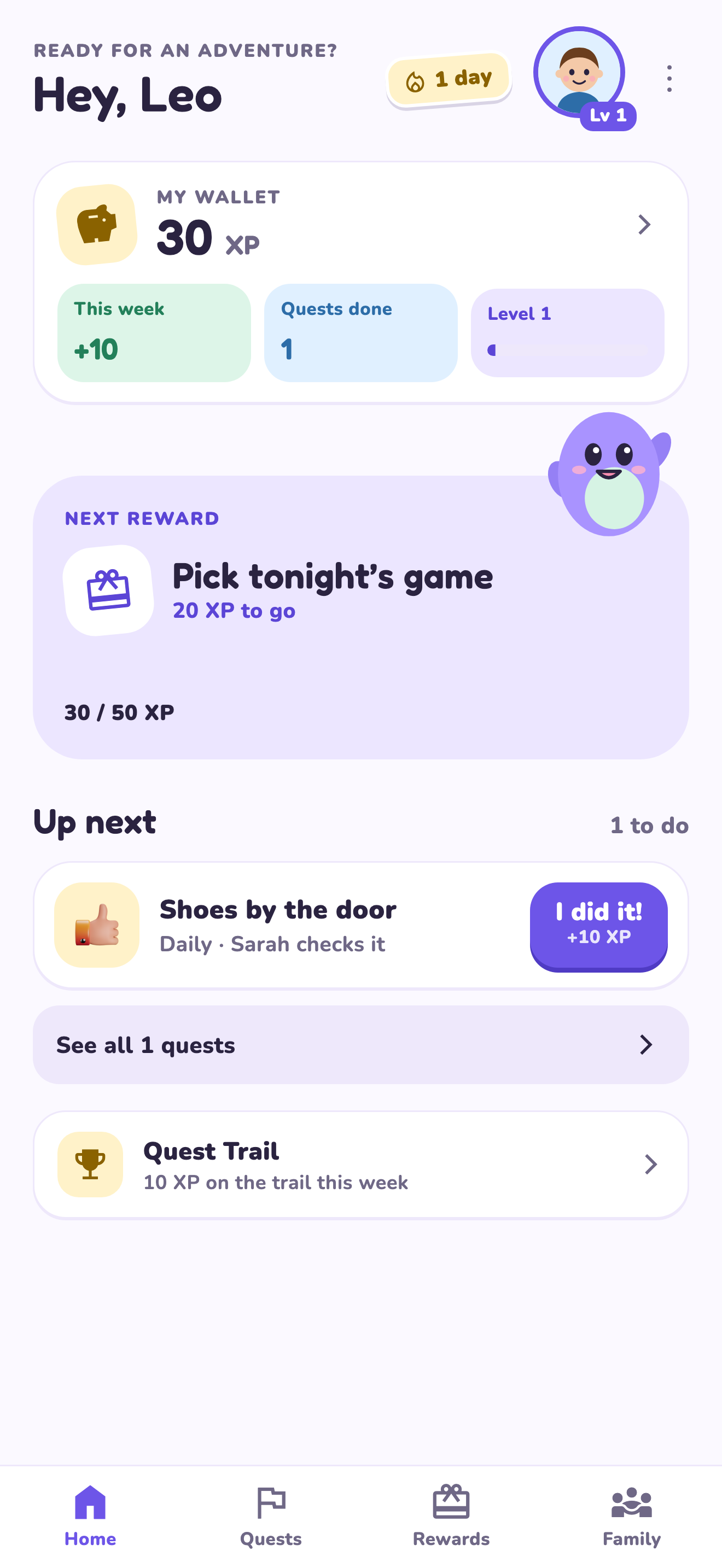
LvlUpKids turns responsibilities into quests, lets a child submit finished work, and lets a parent review it before approved XP goes toward a family-chosen reward. See how LvlUpKids turns chores into parent-approved quests, XP and chosen rewards.
The website template is separate from your account. Edit and print locally, then manually enter selected tasks in the app if you want the quest workflow. There is no automatic import, account save or AI connection on these pages.
Explore the chore app · Free to download, with in-app purchases. Check the store and purchase screen for current device requirements and terms.